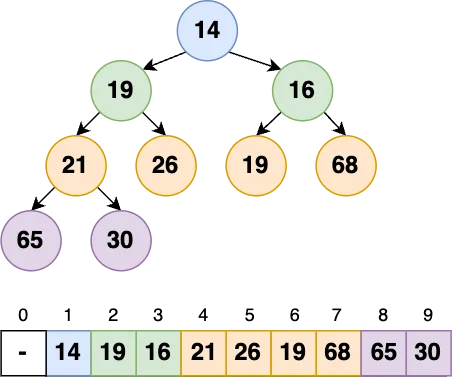
The Heap is a Tree-based data structure where the tree is a complete binary tree. It allows storing duplicates. Despite the Tree-based visualization, Heap is implemented using an array.
In many cases, the Heap data structure is also referred to as a Priority Queue.
📝
A complete binary tree is a type of binary tree where all the levels are filled completely, except the lowest level nodes, which are filled from as left as possible.
For simplicity in accessing elements, the implementation described below assumes that heap indexing starts at 1, not 0. The 0th element is filled with a null value.
If the parent’s value is larger than the current node’s value (heap[i/2] > heap[i]), we swap them and run step №2 again from the new position
If the parent’s value is smaller or equal we exit from the loop
// Time Complexity: O(log N)publicvoidpush(Tvalue){heap.add(value);// add value to the endinti=heap.size()-1;while(i>1&&heap.get(i)<heap.get(i/2)){// Swap child and parent node values until// the parent is less then the inserted valueswap(i,i/2);i=i/2;}}
The deletion process of the top element of the heap, and then organizing the heap and returning the deleted element with time complexity O(log N).
Extract the top value (heap[1])
Put the last node to the top (heap[1] = heap[heap.length - 1])
Percolate the top node down until it’s in the right position:
Pick a minimum of two children
Compare the picked minimum node to the current element
If the child is smaller, we swap the nodes
// Time Complexity: O(log N)publicintpoll(){if(heap.size()==1)returnnull;// Heap is emptyif(heap.size()==2)returnheap.remove(1);// Heap contains 1 elementintresult=heap.get(1);// Get first (root) element // Move the last value to the rootheap.set(1,heap.remove(heap.size()-1));// Percolate root value down the heapinti=1;while(i*2<heap.size()){intminIdx=i*2;intrightChildIdx=i*2+1;if(rightChildIdx<heap.size()&&heap.get(rightChildIdx)<heap.get(minIdx))minIdx=rightChildIdx;if(heap.get(i)<heap.get(minIdx))break;swap(i,minIdx);i=minIdx;}returnresult;}
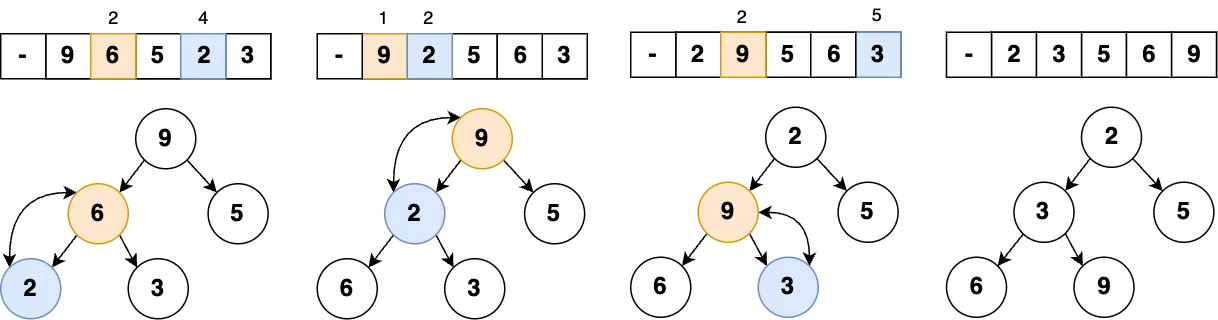
Percolate the node down until it’s in the right position:
Pick a minimum of two children (i/2 and i/2+1)
Compare the minimum child to the parent
If the child is smaller, we swap the node
// Time Complexity: O(N)privatevoidheapify(int[]items){heap=newArrayList<>();heap.add(null);// first index element is unused// Add all items to the heapfor(intitem:items)heap.add(item);// Percolate values down the heapfor(inti=heap.size()/2;i>=1;i--)percolateDown(i);// see "poll()" method}